Scientific Learning
Stop teaching and help your students learn! An educational approach shared by Chris Meyer
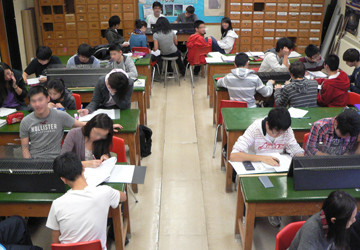
A Scientific Revolution
for education
Teaching is experiencing a transformation from an art into a science. Insights from physics education research, cognitive psychology, and neuroscience are coming together to create a new science of learning. Through this website, I am sharing my efforts to harness this new science and design a scientifically-informed learning environment for my students. Here you will find my teaching resources, videos of my lessons, and my presentations, hoping that these will encourage you to try your own experiments with scientific learning.
Best wishes for better education!
TDSB Hybrid-Teacher Coach Pilot Project Success!
June 2019
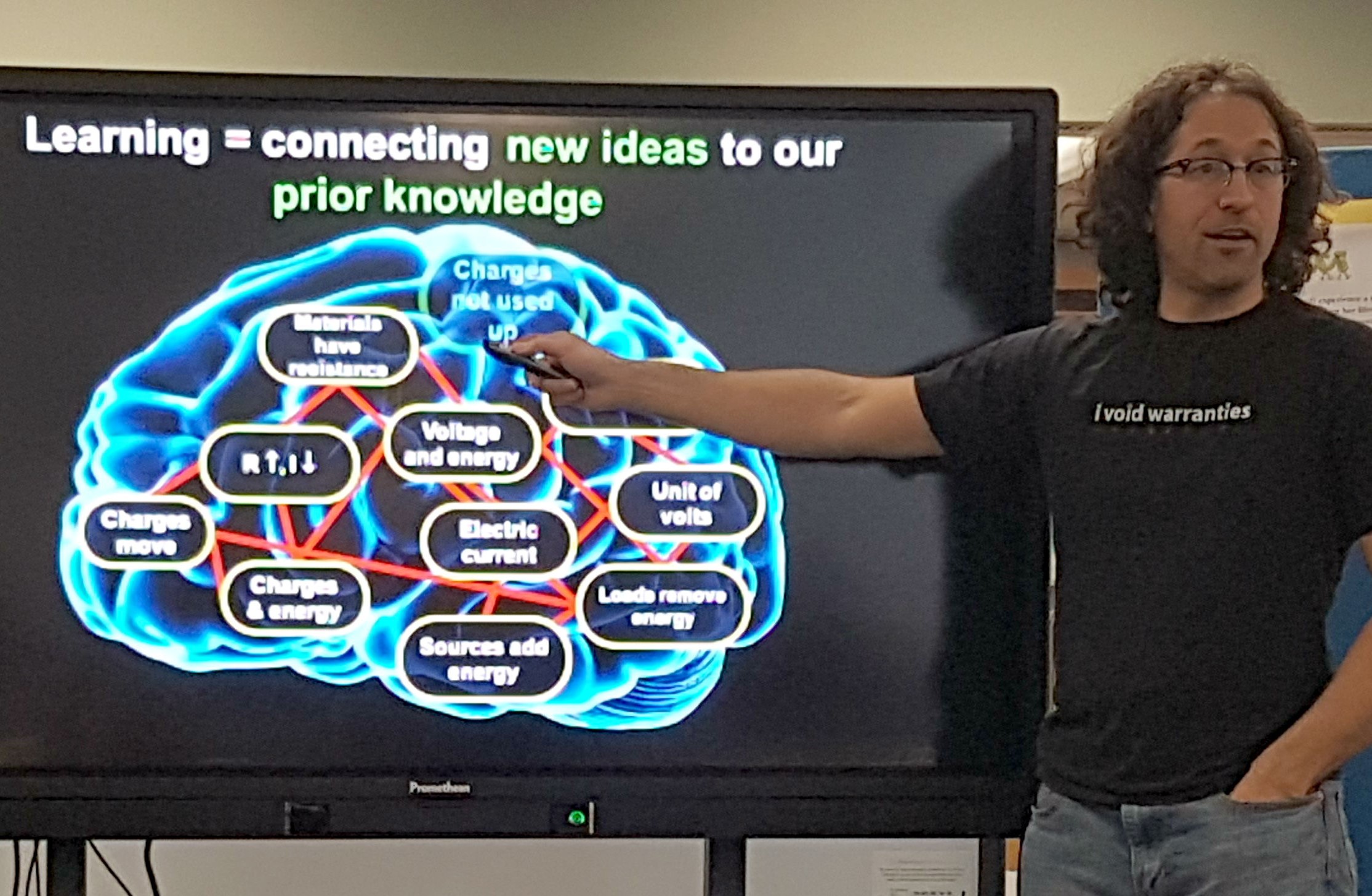
The TDSB has approved the hybrid teacher-coach model for a second year. This year, I was joined by seven other hybrid teacher-coaches in different subject areas. We have had great feedback about the role, which seems to be filling an important niche in the school board. Teachers need course-specific subject expertise to help with their day-to-day teaching. They also need to see novel pedagogy in action, so a coach and mentor teacher who still has an active classroom can meet these two important needs.
TDSB's First Hybrid-Teacher Coach
Spring 2018
In partnetship with the TDSB, I have spent the past semester as our first Hybrid Teacher-Coach: I teach my regular class in the morning and have my afternoons free to coach and mentor science teachers. I suggested the creation of this role o address a long-standing problem with professional development for teachers. How often have you been told to change your teaching by someone who has never tried the new ideas that are being suggested? Teachers need to see new pedagogy in action, hence the design of this new role. Follow my exploits on Twitter! @ChrisMeyerSci
New Static and Current Electricity Unit for Grade 9 Science
Fall 2018
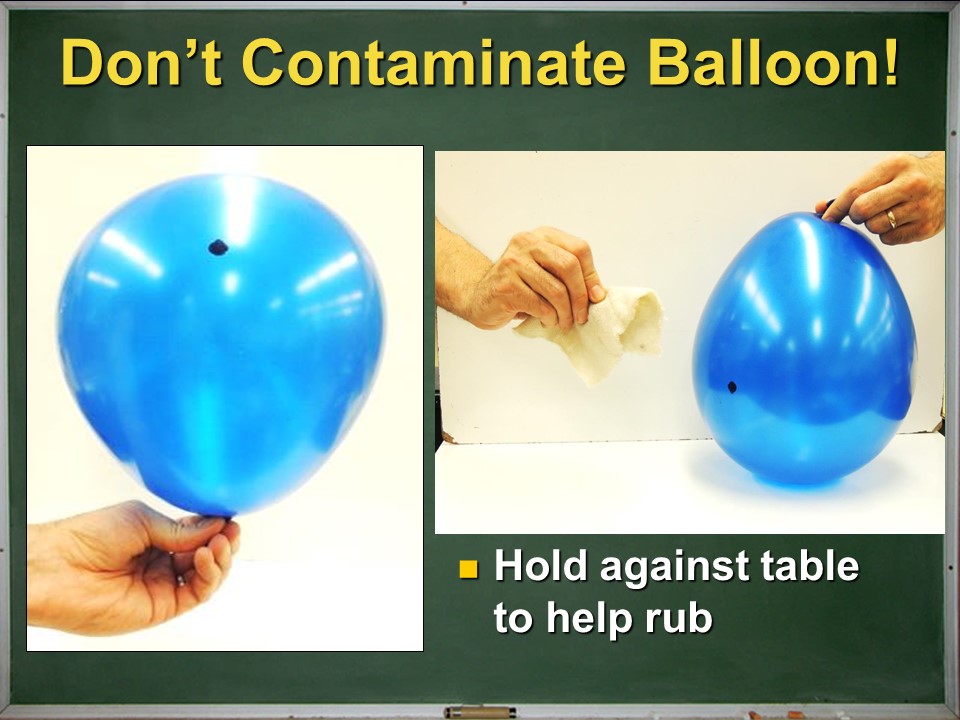
I have written a new unit that introduced the ideas of static electicity and builds a concpetual bridge to current electricity. I haven't actually taught the lessons yet, but I thought I would share them anyways!
Updated 11 and 12 Physics Resources
Fall 2018
Lots of tweaks to the grade 11 and 12 course materials. I have added more metacognition for the early grade 11 homework. The grade 11 force and motion units have a stronger focus on the idea of modeling. Current electricity has been revamped and streamlined for better conceptual focus and skill development.
Check out the resources here for more info.
Canadian Association of Physicists
2016 Award for Excellence
in High School Teaching
was awarded to:
Christopher Meyer, York Mills Collegiate Institute, for his outstanding work in reforming the high school physics curriculum in a manner that has produced demonstrable improvement of student performance over a sustained period.
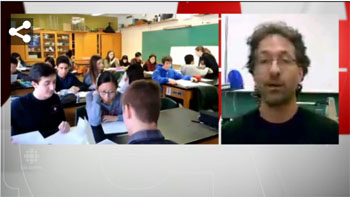
CBC Interview: Nobel Prize and Physics Teaching
October 6, 2015
Today the Nobel Prize in physics was awarded to Canadian physicist Arthur McDonald for his work on neutrino oscillations. I heard a bit about it on the news during my drive in and I talked about it to my first period class, but little did I realize that I would be interviewed by CBC Newsworld before noon! Click the image for the interview.
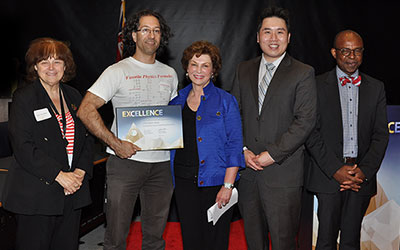
Toronto Disctrict School Board
Excellence Award
In May 2015 I received the TDSB Excellence Award. Read more about it.
New Classroom Videos
I have started creating a set of videos of my classroom teaching to help illustrate what reformed physics teaching looks like in action. You will find a variety of lessons from grades 11 and 12 physics. The videos are captioned with my explanations for many of the techniques I use. A link with each video provides you with the handout for that lesson. Check them out!
Assessment: The Silent Killer of Education
Erik Mazur, a leader in the Physics Education Research community, presents his thoughts on the role assessment. This presentation has had a powerful effedct on my teaching this last year and has caused me to think deeply about how and why I assess and how that assessment supports or conflicts with our inquiry-based learning.
TED Talk: Learn Science by Doing
Frank Noschese is an outstanding high school teacher who advocates for active learning science instruction. Follow his blog for a wealth of teaching insight.
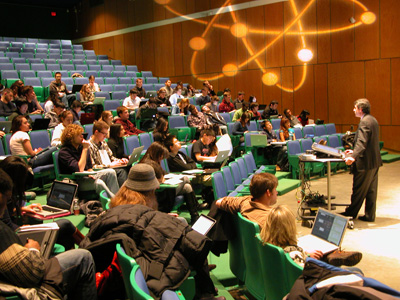
NPR: Physicists Seek To Lose The Lecture As Teaching Tool
January 1, 2012
The lecture is one of the oldest forms of education there is.
"Before printing someone would read the books to everybody who would copy them down," says Joe Redish, a physics professor at the University of Maryland.
But lecturing has never been an effective teaching technique and now that information is everywhere, some say it's a waste of time. Indeed, physicists have the data to prove it.
Confessions of a Converted Lecturer
Eric Mazur: "I thought I was a good teacher until I discovered my students were just memorizing information rather than learning to understand the material. Who was to blame? The students? The material? I will explain how I came to the agonizing conclusion that the culprit was neither of these. It was my teaching that caused students to fail! I will show how I have adjusted my approach to teaching and how it has improved my students' performance significantly." Eric Mazur is the Balkanski Professor of Physics and Applied Physics at Harvard University. An internationally recognized scientist and researcher, he leads a vigorous research program in optical physics and supervises one of the largest research groups in the Physics Department at Harvard University.
Creating Better Physics Learners
Training more high-school physics teachers and increasing student learning are two of the challenges facing math, science, and engineering education in the United States. Noah Finkelstein is an Associate Professor of physics at the University of Colorado at Boulder, conducting research in physics education. As director of the Physics Education Research group at Colorado, he studies conditions that support students' interest and ability in physcs. The sub-discipline of physics education research is now well established and boasts robust lines of research that range from investigations of student learning of specific topics (e.g., how students understand propagation of light) to implementing and studying the implementation of educational reforms and what makes them work or not work.